
Notifications
All caught up!
No notifications yet. When you get interactions, they'll show up here.
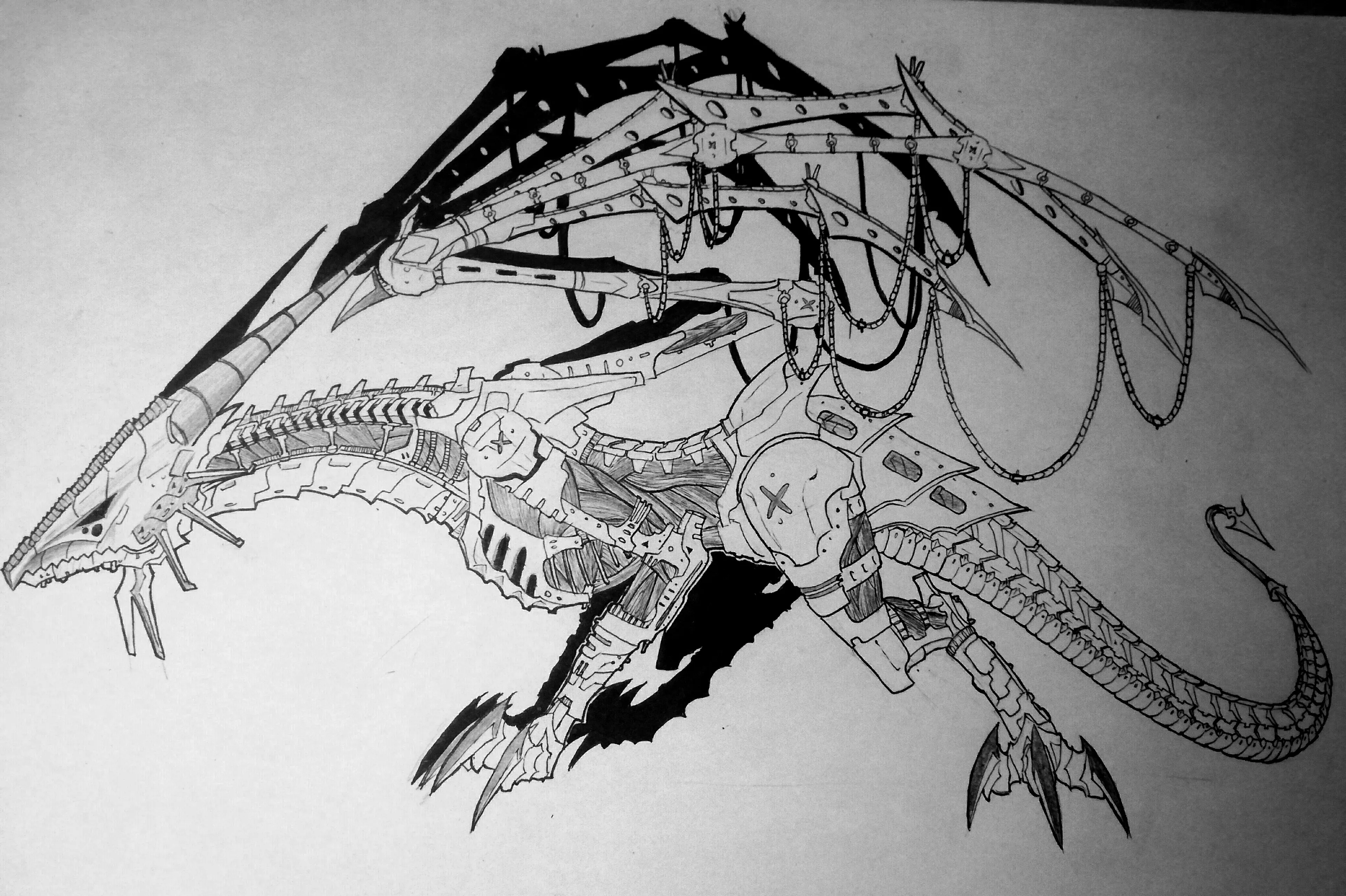


Synkkä's design is based entirely on the anatomy of a natural dragon: a carbon-titanium alloy frame imitates the skeleton of these creatures while maintaining a good lightness/solidity ratio.
On top of this are carbon-platinum fibres reproducing the musculature of a dragon, offering flexibility, strength and resistance thanks to materials of our own making. Like organic muscle fibres, the carbon-platinum fibres shorten when an electric current is passed through them, while gaining in strength. There's no need for servomotors, actuators or any other device to produce movement that offers only a few degrees of freedom. Here, these artificial fibres allow all the movements possible for a dragon, and more.
To protect these very strong muscles, polymer plates offer freedom of movement with a good compromise between flexibility and rigidity. It also provides complete protection against natural corrosion as well as acids and electrical currents.
This material is undoubtedly one of the most surprising aspects of Synkkä: the plastic is capable of self-regeneration thanks to a vascular system supplying the entire body. The porous plastic sheets allow the passage of these vessels and the delivery of replacement molecules that can be derived directly from organic matter. This means that all Synkkä has to do is ingest organic matter to store enough to remake the plastic parts if they were to break down.
If a vessel has to be cut open, it can also close itself up as it is made from the same material as the plastic armour: no bleeding possible.
However, synthesising the plastic requires a metal that cannot be found in the natural environment, so it has to be replenished when reserves are low. Autonomy is nevertheless excellent, thanks to the low consumption of this metal and the high resistance of the plastic, which is unlikely to be damaged.
Above all, the ingestion of organic matter is not vital to the machine; it is only used for regeneration and as a source of energy in emergencies. Synkkä can function perfectly normally without it.
The body of this machine is fully protected, whether by metal, rigid or flexible polymers. There are no gaps in the overall structure of the individual.
The head, which houses most of Synkkä's sensors, optics and processing centres, has naturally been fully armoured with high-resistance metal. Few moving parts required more flexible plastic parts, such as those on the neck or back.
In terms of weaponry, this machine has been equipped with a complete arsenal capable of dealing with all known threats, conventional or otherwise.
It's a simple but surprising idea to have decided to use the most malleable and readily available weapon: air.
Synkkä is one of the few weapons to work with a portable fusion reactor, otherwise found in space equipment. Such machinery generates an immense amount of heat that can be harnessed in the form of a weapon.
The tail acts as a heat sink, storing the excess heat and hiding it under a thick armour that provides a drastically reduced heat signature. In combat, this heat can be used in a variety of ways.
Like a spit of flame, Synkkä can eject burning air from its mouth. This heat is enough to cause severe burns to body tissue and to melt scales or plastic. However, it can do nothing against metal, bone, horns or pectoral plates.
This air is hot enough to be sensitive to magnetic fields, allowing it to be channelled in the form of beams or pulses. Unlike a spray of air, in which the energy is dispersed, a beam of air, and above all an impulse, concentrates much more energy in a reduced volume intended to impact a smaller surface.
The result is a kind of 'cold' plasma capable of piercing even the hardest materials and even piercing a target through and through.
The smaller mouth offers less firepower than the wings, which can deliver high-powered shots.
The arm and outer finger of each wing is capable of producing a much longer, more directed magnetic field.
In the natural position, the magnetic field produced is short, allowing dispersed air fire at short range.
When the wings are extended forward, the outer finger is in line with the outstretched arm, tripling the length of the magnetic field and enabling a very long-range, highly accurate wave to be projected.
The cabling connecting each finger diffuses and directs the air backwards, enabling flight: rather than flapping its wings, Synkkä ejects hot air at high speed. The cabling is elastic, so it can continue to perform its role even when the wings are extended. Similarly, the wings can be used as a weapon, ejecting hot air to defend the rear, but they can also form a fiery curtain if Synkkä wraps himself between his wings.
As an extra measure of protection, they can even generate a veritable plasma for defensive purposes, vaporising any small- or medium-calibre projectiles thrown at them.
If discretion isn't an option, the heat can be diffused throughout the body to ensure that opponents trying to come into contact with Synkkä can't strike a blow. Not twice, in any case.
Finally, air can also be expelled through vents located on the neck, chest, back and pelvis to generate a large burning cloud all around the machine.
Its anti-dragon weaponry is the very best in the anti-Ether field.
A beam of electrons, completely harmless to organic tissue, spat out of the mouth breaks up the Ether in the atmosphere and literally forces autocatalysis in mid-air.
The Ether around the electron beam disappears violently in ocean-blue flames, pulverising everything in contact with it. What's even more amazing is that this electron beam can explode the Ether in a dragon's body.
As Synkkä uses absolutely no Ether in any of his weapons, he is completely immune to this electron beam as well as to all types of anti-Ether and Ether-locked weapons.
More conventionally, Synkkä is equipped with sharp metal claws that can electrify and sound or even paralyse its targets, or heat up white-hot to cut through harder materials.
A retractable harpoon at the end of its tail can be used to hold down distant prey, preventing it from fleeing or taking flight while bringing it to the ground. Also electrified, it can incapacitate opponents from a great distance and bring them towards it.
The wingtip thrust work in the same way as the claws, but are longer. They are certainly less manoeuvrable due to their positioning and articulation, but Synkkä can perform wider sweeps with them.
Its powerful jaws are capable of crushing and shredding, but not cutting. Metal can be bent but will still remain in one piece. The thinner layers can be punctured by the fangs, while the flesh is inevitably splintered.
Its perforating horns are more aesthetic than utilitarian. They can, however, be used to impale targets and possibly hit vital organs directly, particularly in the chest.
© 2026 GeirfinnaLieselotte - SANC-38 Synkkä
Report Content
Designed for DreamingDragons by:
ArchangelGCAFor Terms of Service and Privacy Policy, please visit: TOS and Privacy Policy.
© 2026 DreamingDragons. All rights reserved.
Discussion